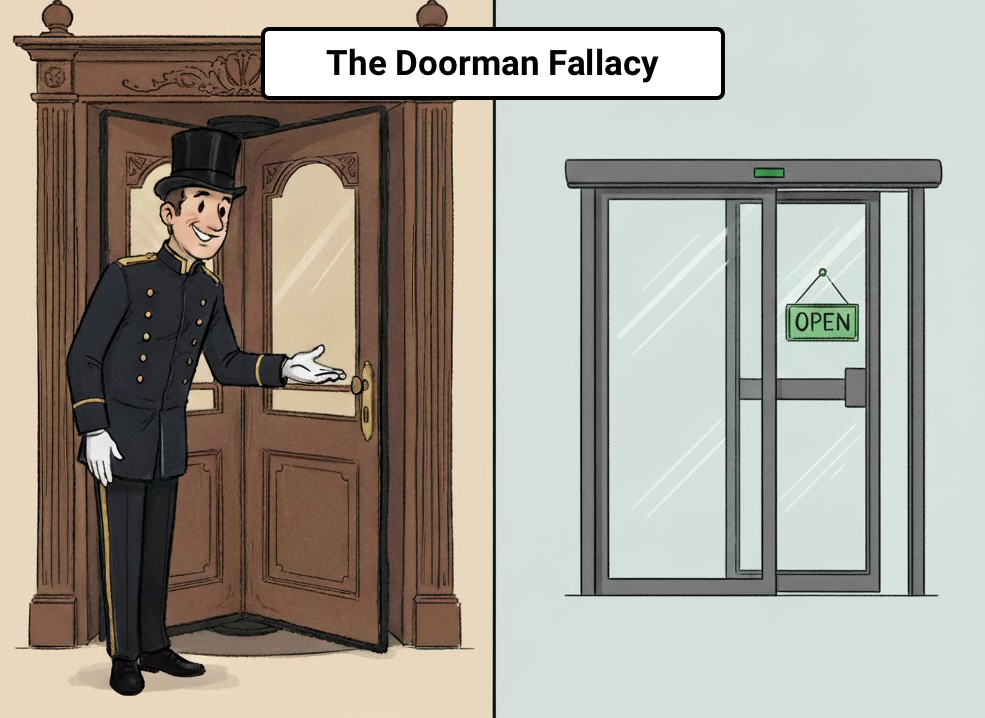
I posted something on LinkedIn last week. No data, no framework, no playbook. Just a simple observation about a doorman and an automatic door. Borrowed (Well stolen really) from Rory Sutherland’s Alchemy and how the rush to automate risks stripping out the human value that was the whole point in the first place.
It performed better than almost anything else I’ve published. That surprised me. Then it didn’t.
Why the Doorman Fallacy matters right now
Most AI content falls into one of two camps, breathless optimism or existential dread. Both treat the human element as a variable to be either celebrated or eliminated.
What nobody is saying clearly enough is that we don’t yet know what we’re automating away.
That’s the Doorman Fallacy. The simple, seductive mistake of believing a job’s logical function is its only function. The doorman opens the door. The automatic door also opens the door it’s cheaper, and it never calls in sick. Logical conclusion is to replace the doorman.
But the doorman’s real job was never mechanical. It was psychological.
The nod of recognition. The reassurance that someone has already decided you belong here. None of that appears on a cost-benefit analysis. All of it is the reason people pay twice as much to stay at the hotel with the doorman.
The pattern is everywhere
I’ve seen this in enterprise AI implementations. A company maps first-line customer support in that they receive a query, look up account, provide information, close ticket. They automate (Automation! not AI. A blog on that soon). Handle time drops. Cost per contact plummets.
Six months later, NPS quietly deteriorates. Nobody can explain why.
Here’s what the model didn’t capture. The customer support agent who noticed a tone shift and flagged a churn risk before it materialised. The one who knew “I’m just checking something” meant “I’m about to cancel.” The one who asked, unprompted, whether everything else was okay.
That’s not inefficiency. That’s the job.
The final thought
The question most AI rollouts start with is whether AI can perform this task? Reasonable. Often right.
But it’s not sufficient. The question that has to follow it: have we actually understood what the human was doing? Not what the job description says. Not what the process map shows. What they were actually doing is including the parts that were never written down, never measured, and never appeared in any efficiency review.
So before you automate, do the anthropology (new favourite word). Sit with the people doing the job, not to map the process, but to understand the texture of it. Where do they deviate from the script? What do they notice that the system doesn’t capture? What do they do after the task is technically complete?
The companies that get this right will be the ones that slow down long enough to understand what they’re replacing and make a deliberate choice about what to keep.
The automatic door is more efficient. The doorman is more effective. Those are different things, and confusing them is expensive.