Google Cloud’s 2026 agent report contains a phrase the whole industry is about to repeat without thinking. The shift, it says, is from instruction based computing to intent based computing. You used to tell the machine how to do a thing. Now you state what you want, and it works out the how.
Put like that, it sounds like a release valve. Less to learn, less to know. State the outcome and step back. That reading is the mistake.
Why the supply side never catches the demand side
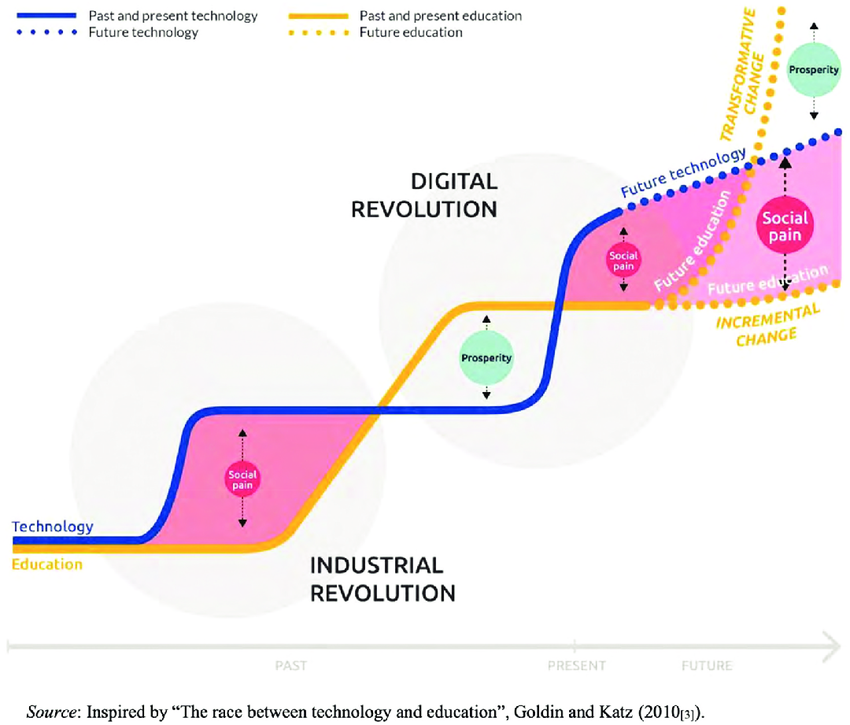
In 2008, two economists, Claudia Goldin and Lawrence Katz, wrote a book called The Race Between Education and Technology. The argument was simple and has aged frighteningly well. Technology raises the demand for skill. Education supplies it. For most of the twentieth century the two ran close enough that prosperity stayed broad. When technology pulled ahead and education could not keep pace, the gap showed up as inequality.
The curve above, adapted from their work, makes the shape of it plain. Where the two lines separate, you get social pain. Where education closes the distance, you get prosperity. The same report selling you intent based computing quietly admits the lines have separated again. It puts the half life of a professional skill at four years, and in tech as little as two. By the time you have finished reading that sentence it is probably less. A degree is a four year lap on a track being resurfaced faster than you can run it.
So intent based computing is not technology easing off to let you catch up. It is technology finding another gear.
Intent is capped by comprehension
Here is what the pitch leaves out. The thing that now scales is the quality of your intent, and the quality of your intent is capped by how well you understand the system you are directing. A vague goal from someone who cannot read the result produces confident nonsense, only faster. A sat nav saves you only if you would notice it steering you into the sea.
The orchestrator you want to hire does not exist. The report is blunt that the agent orchestrator role has no settled market yet. You cannot buy the finished article, because nobody has finished becoming one. This is the Ready Made Talent problem again: the instinct is to acquire the skill fully formed, and there is none on the shelf.
Orchestration assumes a system you can trust. I do not accept that everyone simply becomes an orchestrator. That only holds when you trust the system, its data and its integrity. Hand a very capable model a goal with no rules and you have not delegated, you have abdicated. It is why I wrote a set of agent principles and standards: an agent is software, and the unglamorous disciplines that kept software reliable for decades apply directly. A named human owner who is accountable, and the narrowest data and tool access that does the job. Without that, orchestration is just hopeful instruction.
Verification is heavier than it sounds. We pump a great deal of information into a blackbox, capable but opaque, then have to pick apart the output where it may have quietly become confused. Checking that is not a glance over the shoulder. It needs guardrails and something close to agent level SRE, where every turn is traceable and behaviour is watched for drift, all of it held inside a standing ethical limit on what can be captured from a user in the first place. You cannot verify what you do not understand, and you cannot govern what you cannot see.
Final thoughts
The honest line in the whole report is in Trend 5: it is tempting to focus on the models and the platforms, but that misses the most critical element, the people. Quite. People remain the critical factor. What has changed is how they have to learn, and on that the market is nowhere near where it needs to be, let alone society’s grasp that this is now a lifelong job rather than a qualification you collect once and file away.
A while ago I argued that leaning on AI risks eroding the hard earned knowledge that made you any good in the first place. The agentic shift sharpens that risk rather than retiring it, because now we hand over the whole task, not a single step. The defence has not changed. Keep enough understanding to give good intent, and enough to catch the machine when it is confidently wrong.
Whatever else is true, we are on this path now. So whatever you do, keep learning. Keep experimenting.