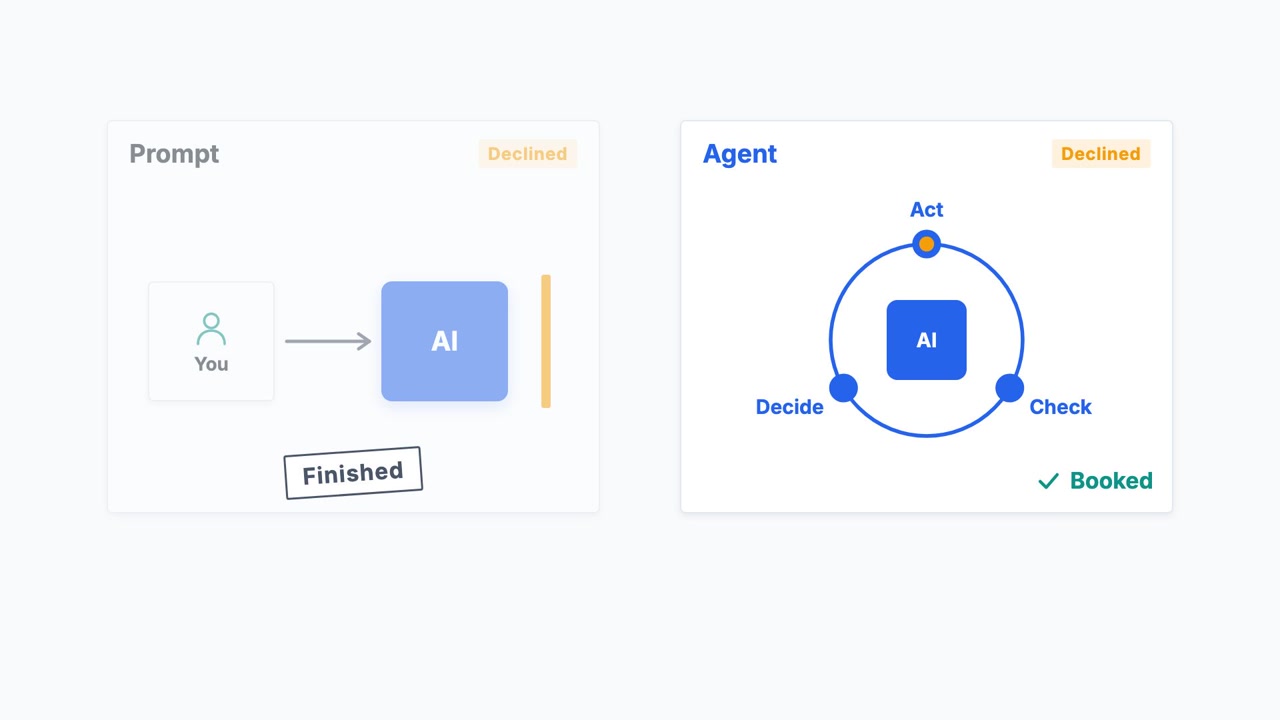
Almost anything an AI does now gets called an agent. A prompt answers once and stops. An agent keeps going until the job is done. This is the difference, shown on one meeting that needs booking.
The word “agent” now gets used for almost anything an AI does, and most of the things it’s used for answer once and stop. That leaves the rest of the job with you.
The video draws the line on one example: a meeting that needs booking with three busy people. A prompt gets you a draft email, and you still send it, chase the replies and rebook. An agent checks the calendars, picks a slot and sends the invitation, and when somebody declines it tries again. That loop, act, check, decide, is what makes it an agent.
The test to carry away is what happens after the first answer. Plenty of things called agents, even ones with your instructions and your documents behind them, stop there. A genuine agent checks its own work against the goal you set and keeps going until the goal is reached.
An agentic process is a piece of work where the AI does the steps in the middle and you set the goal and check the result. It’s the difference between asking a colleague a question and handing them the job, with one warning: an agent can carry a mistake through every step, so the checking stays with you.
No products are named. The definitions follow Anthropic’s engineering guide on building agents, checked in September 2026. This is an independent explainer, not affiliated with any vendor.
Transcript
Almost anything an AI does now gets called an agent. Often, the thing they're describing answers once and stops. The difference is who does the work after the first answer.
A prompt is what you type. You ask once, the AI answers, and it stops. Say you need a meeting with three busy people. You ask for an email suggesting times, and you get a draft. You still send it, chase the replies, and rebook when somebody declines.
Give an AI a goal, some tools and permission to keep going, and you have an agent. It takes the same meeting, checks all three calendars, picks a slot and sends the invitation. Nobody typed those steps, because it chose them itself.
Now say one person declines the invitation. What does the prompt do, and what does the agent do?
The prompt does nothing, because it finished when it answered. The agent sees the decline, picks another slot and sends a new invitation. That loop is what makes it an agent. It acts, checks the result against the goal, and decides what to do next, until the meeting is booked.
Plenty of things called agents answer once and stop, even with your instructions and your documents behind them. The test is what happens after the first answer. A genuine agent checks its own work against the goal you set, and keeps going until that goal is reached.
An agentic process is a piece of work where an AI does the steps in the middle. You set the goal at the start and check the result at the end.
It's the difference between asking a colleague a question and handing them the job. An agent can carry one mistake through every step, so the checking stays with you.
If it answers once and stops, the rest of the job is still yours. If it checks its own work and keeps going until the goal is reached, it's an agent. A prompt gets you an answer, and an agent gets the job done.
Found this useful?
Subscribe for the next one, or tell me what you want explained. I take requests.