How a database finds what you mean rather than the words you typed, and how that lets an AI answer from your documents. Meaning as numbers, the nearest pieces found fast, and why the answer is only as good as what was found.
A search that matches words can miss the one article you need, because the article and your question share none. This video shows how a vector database finds it anyway. An AI model turns each sentence into a long list of numbers, and sentences that mean similar things get lists that sit close together, like points on a map where distance is meaning. The database keeps those lists the way a book’s index keeps entries, each pointing back to its piece of text, and it looks the index up by meaning rather than by word.
It then shows how that search sits behind an AI. The nearest pieces are handed to the AI with your question, and it writes its answer from them, with no training on your documents at all. That is also the limit: a wrong piece found gives a wrong answer given with confidence. It ends on where the search lives now, in databases built for it alone and as a feature inside the relational and document databases companies already run.
Every claim was checked against the embedding documentation of OpenAI, Anthropic and Google, the documentation of Pinecone, Qdrant, pgvector, Milvus and Weaviate, and Anthropic’s published retrieval figures in September 2026. No product is recommended. This is an independent explainer, not affiliated with any vendor.
Transcript
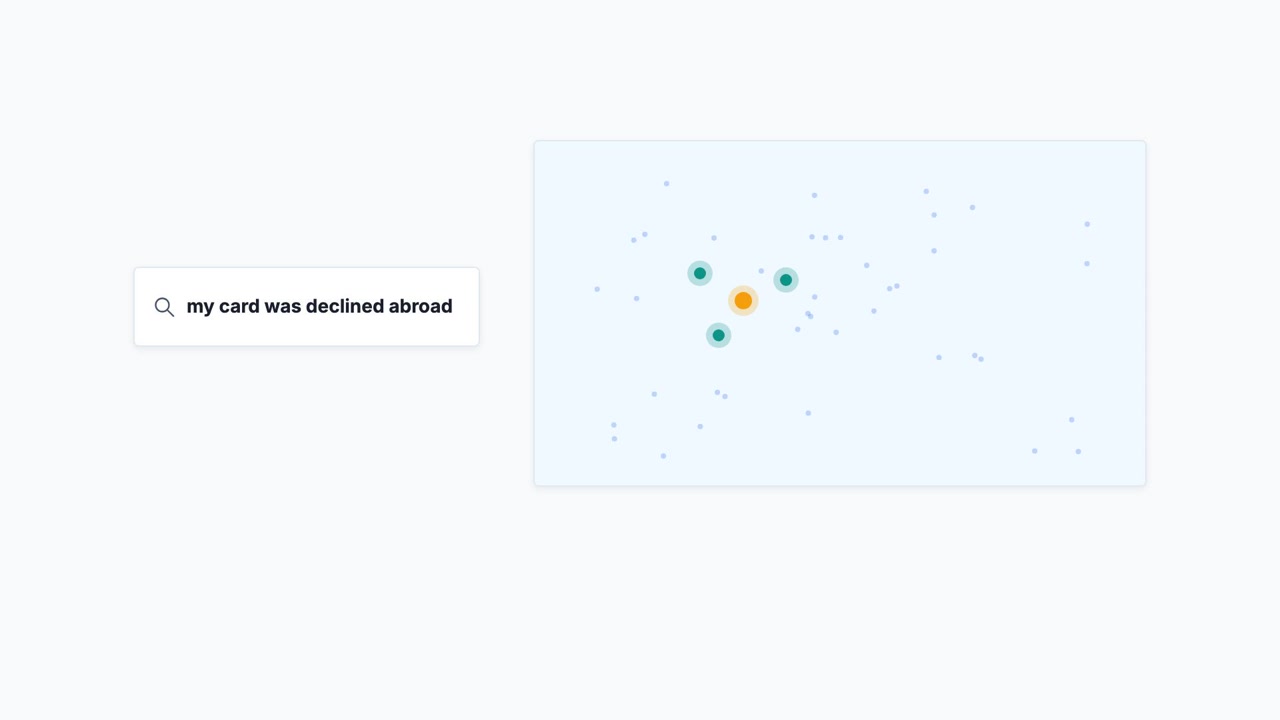
Say you type "my card was declined abroad" into a help page. The right article is called "Overseas transaction limits", and the two share no words at all. A search that matches words finds nothing. To find it, the search has to understand what you mean.
An AI model can turn a sentence into a long list of numbers, hundreds or even thousands of them. Sentences with similar meanings get lists that sit close together, and different meanings sit far apart. Think of it as a map, where distance is meaning.
A vector database holds those lists, and it works like the index at the back of a book. Every document is cut into pieces of a few hundred words, and each piece becomes an entry, its numbers, with a page reference back to the text it came from. The difference is that you look this index up by meaning, not by the word.
Your question is turned into numbers the same way. The database finds the stored pieces whose numbers sit nearest to it, and those are the pieces that mean what you asked. It never looked at the words.
Now say there are ten million pieces stored. Does it measure the distance to every single one?
Not usually, because it follows shortcuts through the map. They reach almost the nearest pieces, almost every time, in a fraction of the time. A little accuracy is the price of answering at once, and most searches happily pay it.
This is how an AI answers questions about your documents without any training on your documents. The nearest pieces are handed to the AI together with your question, and it writes its answer from them.
That also sets the limit. The AI answers from what was found, so if the wrong piece is found, the answer is wrong with confidence. In one published test, plain retrieval missed the right piece about one time in twenty searches.
Some vector databases are built for this search and nothing else. The same search has also been added to the relational and document databases that companies already run. So it is sometimes a product of its own, and sometimes a feature inside the database you already have.
A vector database turns meaning into numbers, finds the nearest pieces fast, and hands their text to the AI. That is how an assistant answers from your documents, and it is only ever as good as what it finds.
Found this useful?
Subscribe for the next one, or tell me what you want explained. I take requests.