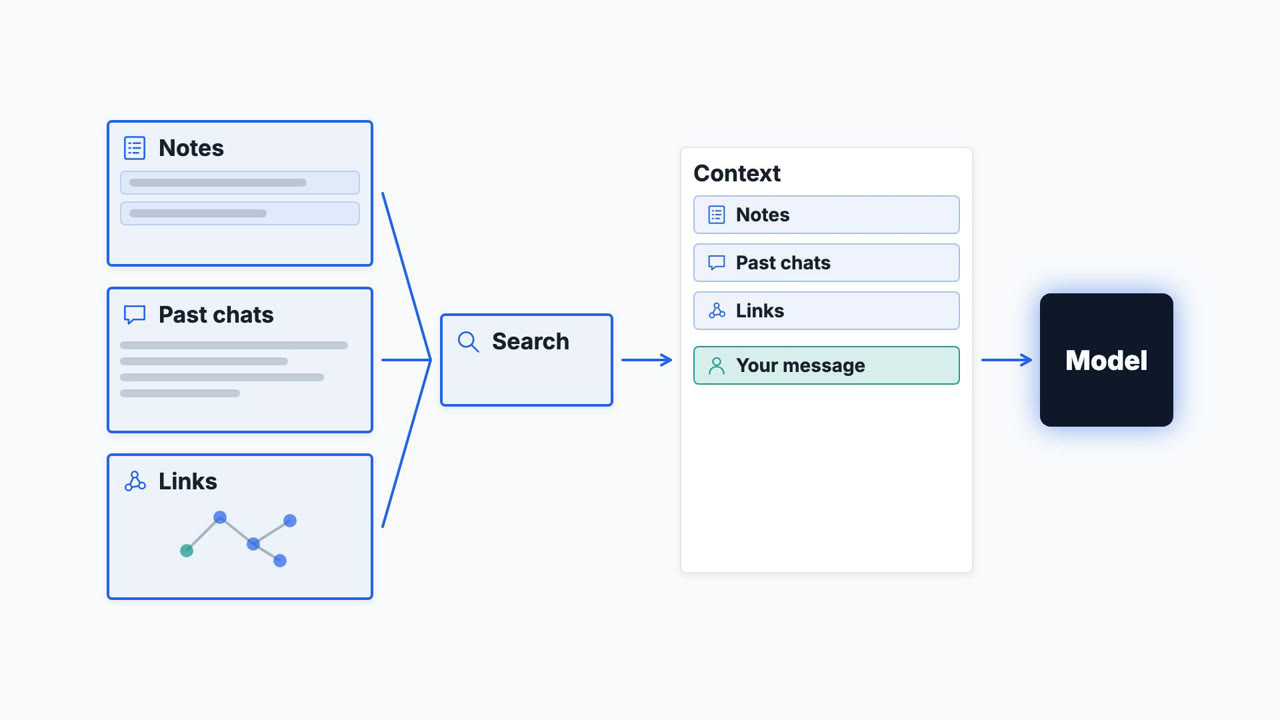
An AI chat that remembers you hasn’t learned anything. The model keeps nothing between answers, so the app keeps notes, past chats and sometimes a graph outside it, and a search puts the right pieces back in front of the model before each answer.
Each time it answers, the model reads only what the app places in its context. Nothing you type changes the model while you use it. What feels like memory is the app writing things down and handing the right ones back.
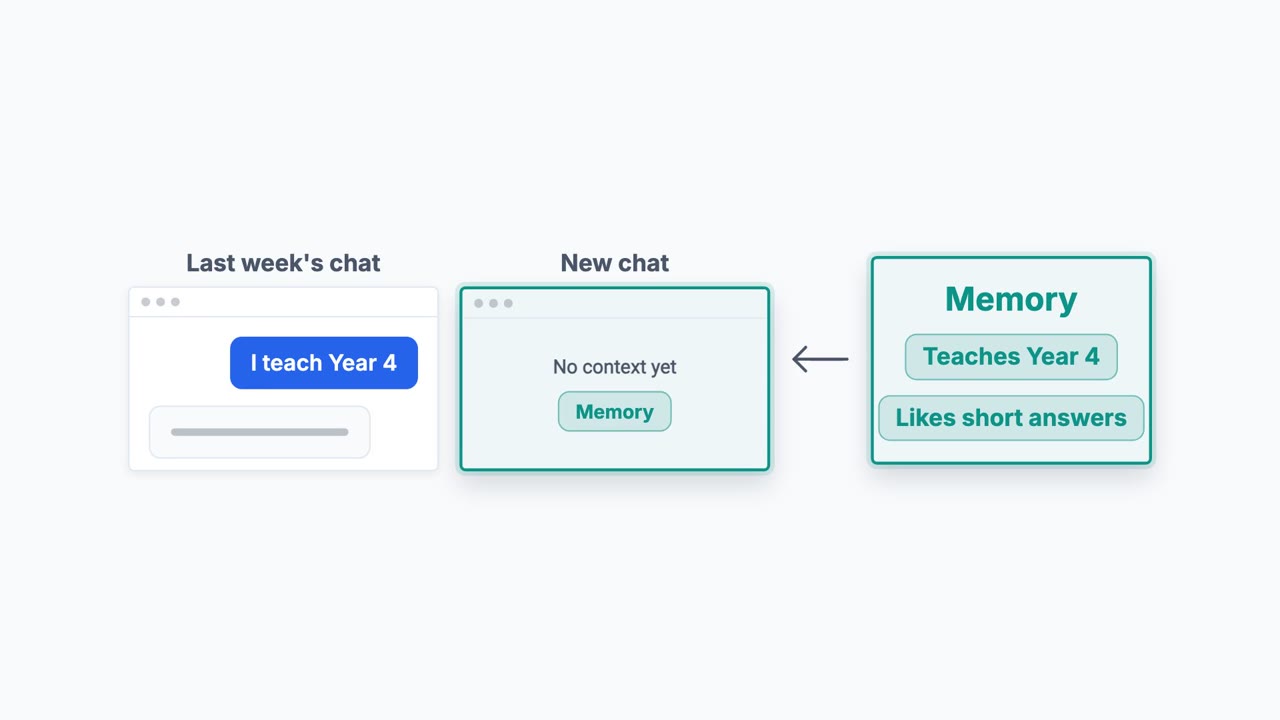
Notes about you. Short facts, such as teaches Year 4 or likes short answers. They’re small enough that many systems put them into the context at the start of every chat. Usually the AI itself decides what’s worth writing down, during the chat or later in the background, then adds a note, changes one or deletes one that has gone out of date.
Past conversations. They’re too long to read every time, so they’re cut into pieces and each piece is stored as numbers that stand for its meaning, in a vector database. A new question becomes numbers the same way, and the search fetches the pieces nearest in meaning.
A graph, in some systems. People, places and projects become dots and each fact is a line between two of them, as in a graph database. A line can carry dates, so the system can tell which facts are current.
Why it still gets you wrong. Say you move to Year 6 and mention it once, in a chat about something else. The note may never be changed, or the search may fetch an old chat about Year 4 as the closest match. The AI writes from whatever reaches the context, even when it’s out of date. ChatGPT, Claude and Copilot show what they’ve saved in their settings, so a wrong note can be fixed where it’s kept. In ChatGPT and Claude, deleting the original chat leaves the note in memory.
This is the general pattern. No maker publishes in full how its own memory is built. Every claim was checked against Anthropic’s and OpenAI’s API documentation, Anthropic’s memory tool, the ChatGPT, Claude and Copilot help pages, OpenAI’s post on dreaming, the LangChain and LlamaIndex memory documentation, and the MemGPT, Mem0, Zep and RAG papers, in November 2026. This is an independent explainer, not affiliated with any vendor.
Transcript of the video
In September you tell an AI chat that you teach Year 4. A month later, in a brand new chat, it plans a lesson for Year 4 without being asked. Nothing you type changes the model while you use it, so what it remembers has to be kept outside the model.
Each time it answers, the model reads only what the app places in its context, and it keeps none of it afterwards. A memory is the app keeping things outside the model, and putting the right pieces back in the context before the next answer.
A memory keeps up to three kinds of thing. There are short notes about you, your past conversations, and in some systems a graph of how people and things are linked. A search then picks what reaches the context.
Notes are short facts, such as teaches Year 4, or likes short answers. They're small enough that many systems put them into the context at the start of every chat.
Something has to decide what's worth writing down. Usually it's the AI itself, during the chat or later in the background. It compares the facts that look lasting with the notes it has, then adds a note, changes one, or deletes one that has gone out of date.
Past conversations are too long to read every time, so they're cut into pieces, and each piece becomes a list of numbers that stands for its meaning, kept in a vector database. A new question becomes numbers the same way, and the search fetches the pieces nearest in meaning.
Some systems also keep a graph. People, places and projects become dots, and each fact is a line between two of them, such as you teach Year 4. A line can carry dates as well, so the system can tell which facts are current.
Some systems search before every answer, and in others the AI decides when a search would help. Either way, what's found is placed in the context beside what you typed, and the model reads it all as part of your message.
Now say you move to Year 6, and mention it once, in a chat about something else. A week later, the AI plans a lesson for Year 4. What do you think went wrong?
The note may never have been changed, because the mention looked like a passing detail. The search may also have fetched an old chat about Year 4, as the closest match. Either way, the AI writes from whatever reaches the context, even when it's out of date.
ChatGPT, Claude and Copilot show what they've saved in their settings, so a wrong note can be fixed where it's kept. In ChatGPT and Claude, deleting the original chat leaves the note in memory.
The model keeps nothing between answers. Its memory is notes, past chats and sometimes a graph, kept outside it, and a search that brings the right pieces back. It can only use what was written down and found.