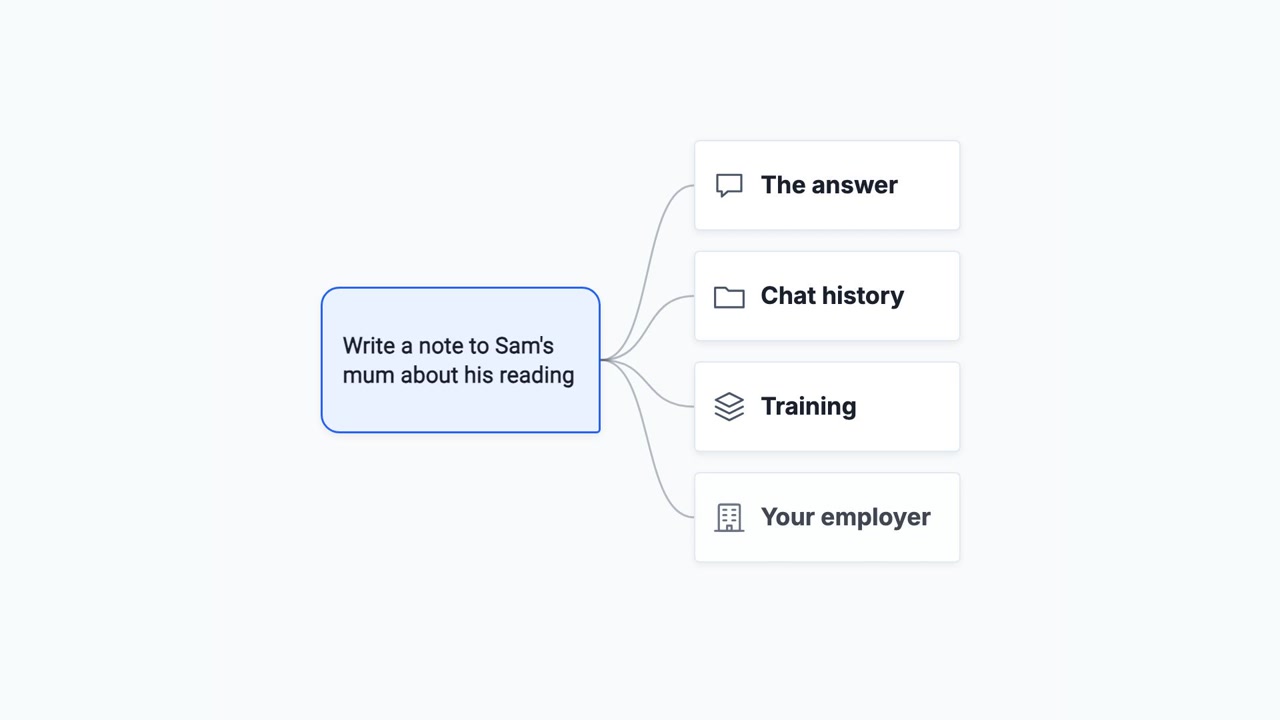
A sentence you type into an AI chat can end up in four places: the answer, your chat history, the training data for future models and your employer’s records. The answer is the only certain one. The other three depend on your settings and on which account you’re signed in with.
The answer. The AI has to read your sentence to reply, so every message goes to the company’s own computers. No setting changes that.
Your chat history. The chat is saved to your account until you delete it. ChatGPT’s temporary chat and Claude’s incognito chat stay out of your history. A deleted chat leaves your list straight away, and ChatGPT and Claude both say it’s removed from their systems within thirty days.
Training. Some apps can use your chats to train their future models. It’s a setting, switched on by default for a personal ChatGPT account and for a personal Gemini account from eighteen. You can turn it off in Claude and in ChatGPT. On work and school accounts, ChatGPT, Claude, Gemini and Copilot don’t train on your chats by default.
Your employer. On a work or school account, your organisation can search and export your chats. On a Google work or school account, it can even keep a Gemini chat you’ve already deleted.
So before you type anything personal, check your settings and whose account you’re in.
The facts come from OpenAI’s help pages on chat retention and data controls and its enterprise privacy page, Anthropic’s privacy and help pages on retention, training, incognito chats and organisation exports, Google’s Gemini Apps Privacy Hub and Workspace help on Vault, and Microsoft Learn on Purview for Microsoft 365 Copilot, read on 13 November 2026. This is an independent explainer, not affiliated with OpenAI, Anthropic, Google or Microsoft.
Transcript of the video
Ask whether an AI chat is reading your stuff, and the honest answer is that it depends, which on its own helps nobody. A sentence you type can end up in four places, and only one of them is certain.
Take one sentence, like a request to write a note to Sam's mum about his reading. It can go to the answer, to your chat history, to the training data for future models, and to your employer.
Every sentence you send ends up in the answer. The AI has to read your sentence to reply, so it's sent to the company's own computers. That happens with every message, and no setting stops that delivery.
The second place is your chat history. Your chat is saved to your account so you can come back later, and it stays there until you delete the conversation. ChatGPT's temporary chat and Claude's incognito chat both stay out of your history.
Say you delete that chat about Sam, and it disappears from your list straight away. Does the company still keep a copy on its computers?
The company's copy is kept a little longer. ChatGPT and Claude both say a deleted chat is removed from their systems within thirty days. ChatGPT may also keep a temporary chat for up to thirty days, for safety.
The third place is training. Some apps can use your chats to train their future models, and whether they do is a setting. Training is switched on by default for a personal ChatGPT account, and for a personal Gemini account from the age of eighteen.
On work and school accounts, ChatGPT, Claude, Gemini and Copilot don't use your chats for training by default.
The fourth place is your employer. On a work or school account, your organisation can search and export your chats. On a work or school Google account, it can even keep a Gemini chat that you've already deleted.
Your sentence always reaches the answer. The other three places depend on your settings and on which account you're using.