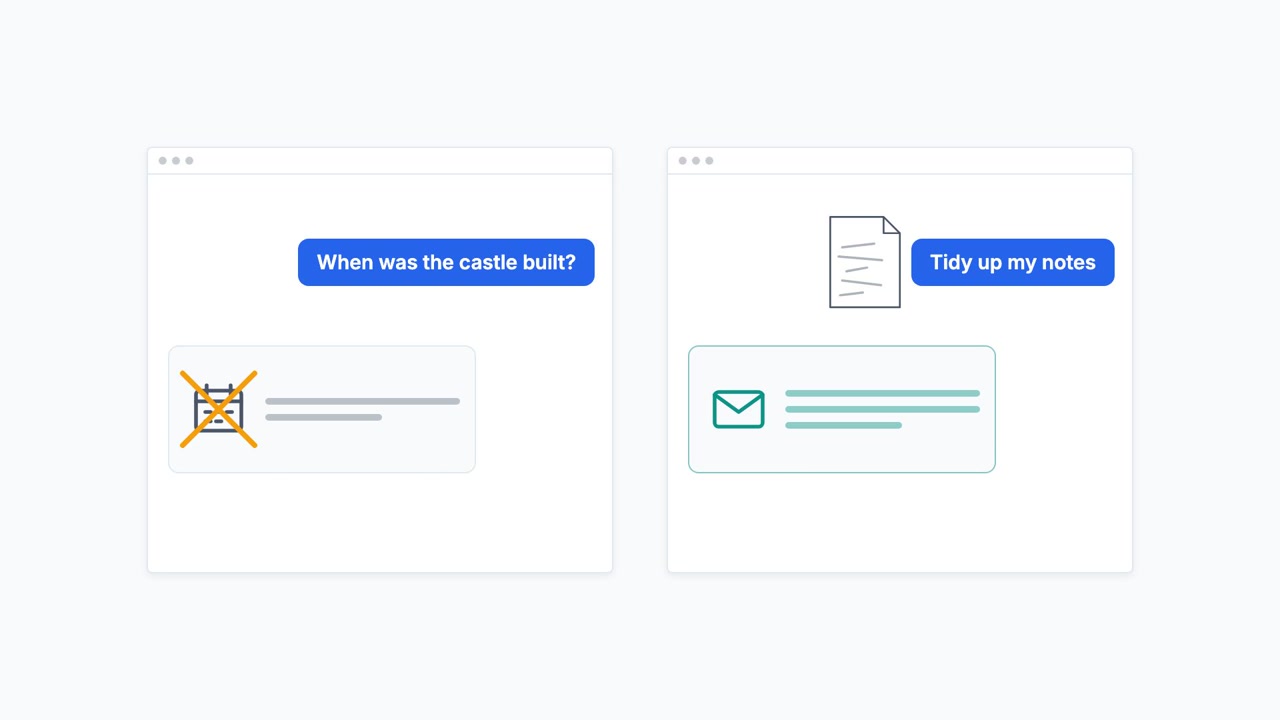
An AI chat is at its best on material you give it, like a report or your own notes, and at its weakest answering from memory, where its guesses sound just like its knowledge. Which answers to trust, and what to paste in first.
An AI chat does two different jobs, and it is far better at one of them. When it works on material you bring to the conversation, such as a long report, rough meeting notes or a letter, everything it needs is already in the chat, so it summarises, tidies and rewrites well. When you bring nothing, it answers from what it learnt in training and writes what sounds likely.
That is where it goes wrong, and it doesn’t reliably tell you. The usual name for it is a hallucination. Researchers at OpenAI asked a model for one of their own birthdays three times and got three different answers, none of them right. In 2023 a lawyer in New York asked ChatGPT whether a case it had given him was real, and it said yes. It isn’t a search engine either: a search engine finds pages people wrote, and an AI chat writes a new answer, though some apps search the web first and give you links. So when an answer depends on a fact, give it the source to work from, such as the castle’s own web page, the policy or the email.
The facts come from OpenAI’s paper “Why language models hallucinate” (Kalai and others, September 2025), the court record in Mata v. Avianca (US District Court for the Southern District of New York, 2023) and OpenAI’s help centre page “Does ChatGPT tell the truth?”, read on 31 October 2026. This is an independent explainer, not affiliated with OpenAI.
The line to keepAn AI chat is at its best on the material you give it. Bring it the material whenever the facts matter.
Ask an AI chat when your local castle was built, and it might get the date wrong. Paste in your meeting notes, and it turns them into a tidy email. One of those makes it look useless, and the other makes it look clever. It's the same tool both times, and the difference comes down to the job it's doing.
A request to an AI chat is usually one of two jobs. In the first, it works on material you bring to the conversation. In the second, you bring nothing, and it answers from memory.
It's strongest on the first job, where it can summarise a long report, turn rough notes into a tidy email, or make a letter sound friendlier. Everything it needs is already in the conversation.
Picture asking for a summary of a report you've just pasted, then for its author's birthday. Which of those two answers would you call reliable?
The summary is the safer bet, because the report is right there in the chat. The birthday has no page behind it, so the AI writes what sounds likely. Researchers at OpenAI asked a model for one of their own birthdays. Over three tries, it gave three different answers, and none of them was the real birthday.
It can look like a search engine that talks, but it works quite differently. A search engine finds pages that people have written, and an AI chat writes a new answer from what it learnt in training. Some apps search the web first, and then you get links you can follow.
It also doesn't reliably tell you when it's wrong, and its guesses sound exactly like its knowledge. In twenty twenty-three, a lawyer in New York asked ChatGPT to confirm that a case it had given him was real. It said yes, and the case had never existed.
When an answer depends on a fact, give the AI the source to work from. For the castle, paste in its own web page. The same goes for a policy or an email. Each one turns a memory job into a job it does well.
An AI chat is at its best on the material you give it, and at its weakest on what it remembers. Bring it the material whenever the facts matter.
Found this useful?
Subscribe for the next one, or tell me what you want explained. I take requests.