Some AI tools split a big job between several AIs, with one in charge called the orchestrator. Each worker sees only the note it was given, and the orchestrator sees only the summaries that come back. This is where that goes wrong, what it costs, and when splitting the work pays off.
Some AI tools split a big job between several AIs. One AI in charge, the orchestrator, hands each piece to another AI, a subagent, and joins what comes back into one tidy answer. It sounds like a team getting the job done faster. The danger is in what each one can’t see.
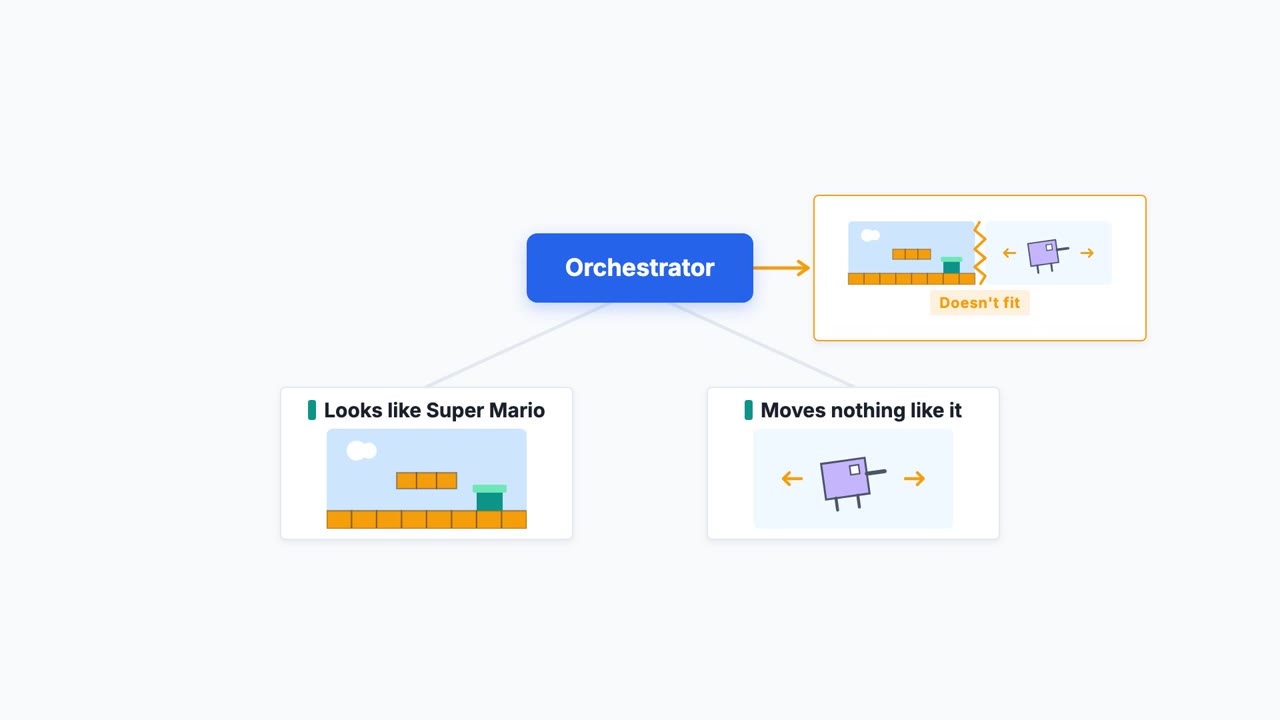
Cognition, a company that builds coding agents, gives an example. The job is a copy of the game Flappy Bird. One subagent is asked for the background, another for the bird, and neither can see what the other is doing. The background comes back looking like Super Mario, the bird moves nothing like the one in the game, and the orchestrator is left joining two pieces that don’t belong together.
Mistakes hide in a setup like this. In Claude Code, a subagent starts fresh and sees only the note the orchestrator writes for it, and the orchestrator gets back a summary, not the work itself. A summary can leave a mistake out, and every step after builds on it. Small chances add up too. If each of five subagents is right nine times in ten, all five are right together only about six times in ten. And it costs more. In Anthropic’s own data, systems like this used about fifteen times the tokens of an ordinary chat.
Splitting the work does pay off when the pieces stand alone, like ten searches running side by side. When the pieces depend on each other, it’s a poor fit. Either way, the checking stays with you. Ask to see what each subagent did, not only the tidy answer.
The sources are Anthropic’s engineering posts on multi-agent research and building effective agents, the Claude Code subagents documentation, and Cognition’s post “Don’t Build Multi-Agents”. This is an independent explainer, not affiliated with Anthropic or Cognition.
The line to keepEvery agent you add gives a mistake one more hiding place.
Transcript of the video
Give some AI tools a big job, and they split it up. One AI hands each piece to another AI, then puts their answers together. It sounds like a team getting the job done faster. So where's the danger?
The AI in charge is called the orchestrator. The AIs it hands work to are called subagents. In Claude Code, a subagent starts fresh. It sees the note the orchestrator writes for it, and none of your conversation.
A company that builds coding agents gives an example. The job is a copy of the game Flappy Bird. One subagent is asked for the background, with its green pipes. Another is asked for the bird that the player controls.
Each subagent works on its own piece. Neither one can see what the other is doing. What do you think could go wrong?
The first builds a background that looks like Super Mario. The second builds a bird that moves nothing like the one in Flappy Bird. Each chose how the game should look, and nobody told the other. The orchestrator is left joining two pieces that don't belong together.
When a subagent finishes in Claude Code, the orchestrator gets back a summary, not the work itself. A summary can leave a mistake out. The orchestrator builds on what it reads, and so does every step that follows.
Say each subagent gets its piece right nine times in ten, which sounds safe. With five of them, all five come back right only about six times in ten. Anthropic's own engineers wrote that errors compound.
Every subagent reads and writes its own text, and AI use is charged by that text, counted in tokens. In Anthropic's own data, systems like this used about fifteen times the tokens of an ordinary conversation.
Splitting the work pays off when the pieces stand alone. For research, with ten searches running side by side, Anthropic found it beat one agent working on its own. Jobs where the pieces depend on each other are a poor fit for splitting.
Handing a job to an orchestrator is still handing it over, and the checking stays with you. Ask to see what each subagent did, not only the tidy answer.
Each subagent sees only the note it was given, and the orchestrator sees only the summaries that come back. Every agent you add gives a mistake one more hiding place.
Found this useful?
Subscribe for the next one, or tell me what you want explained. I take requests.