AI is sold as time back, but the gain rarely turns up as a free hour. It shows up as time on a first draft, quality from a second look, and reach for work you'd never have started, followed through one teacher's week.
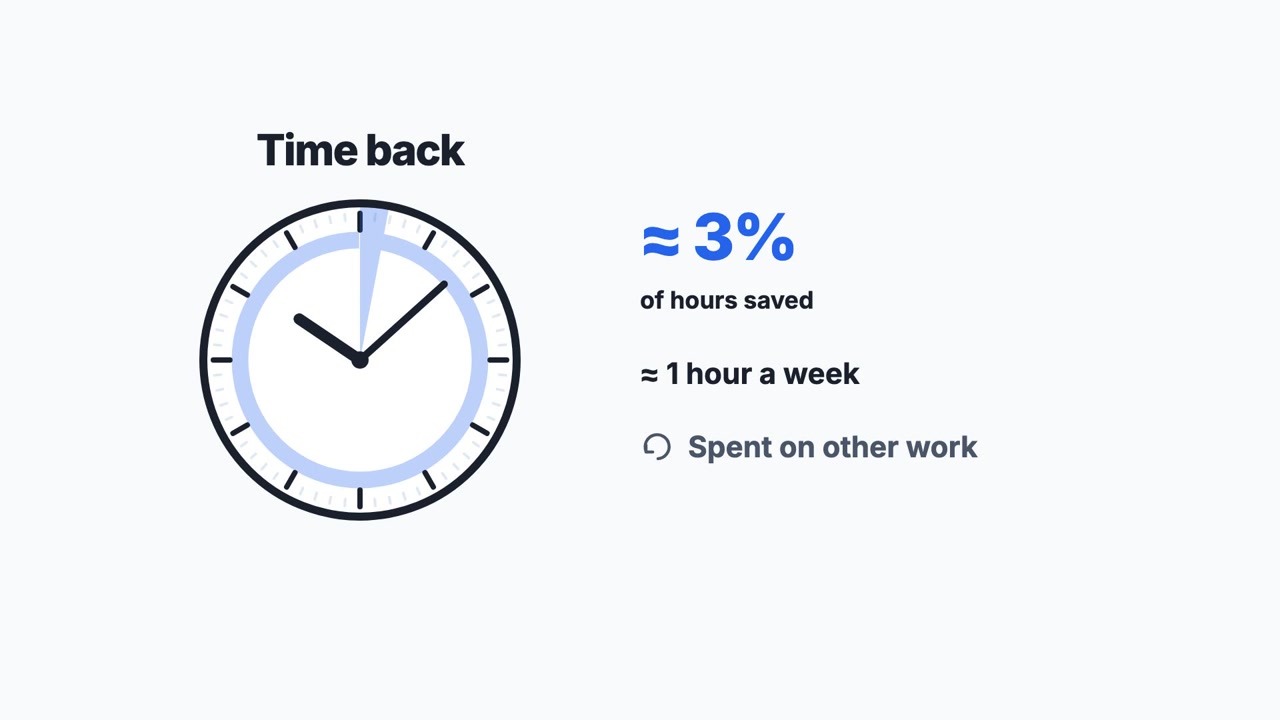
The pitch for AI is that it gives you time back. Danish workers who use AI chats report saving about three per cent of their hours, roughly an hour a week, and most of them spend it on other work. So the gain rarely turns up as a free afternoon. It turns up in three places. Take one teacher, Sam, and a week that has all three.
Time comes from skipping the blank page. A letter home that usually takes forty minutes takes a minute to draft and ten to put right.
Quality comes from a second pair of eyes. The AI spots a harsh line in a difficult email, which saves no time and still makes the email better.
Reach is the work you’d never have started, like a reading quiz at three levels.
On a stopwatch Sam’s week breaks even, and it is still a better week. Your own sense of the minutes saved isn’t reliable either. In one small study, experienced programmers believed AI had cut their time by a fifth, and on the clock they took nineteen per cent longer.
The figures come from Humlum and Vestergaard, “Still Waters, Rapid Currents” (NBER working paper w33777, revised March 2026), Noy and Zhang in Science (July 2023) and Becker and others at METR (2025). Sam’s week is an illustration, not data. This is an independent explainer, not affiliated with any AI company.
The line to keepThe gain turns up as time, quality and reach. A stopwatch measures only the first.
Transcript of the video
The pitch for AI is that it gives you time back. Danish workers who use AI chats report saving about three per cent of their hours, roughly an hour a week. Most of them spend that hour on other work, so it rarely turns up as a free afternoon.
The gain turns up in three places, and one teacher's week has all three. Picture Sam, who teaches a primary class and uses an AI chat on three days of the week, Monday, Wednesday and Friday.
On Monday, Sam needs a letter home about a school trip, which usually takes forty minutes. An AI chat writes the first draft in a minute, and Sam spends ten minutes putting it right. Time is the first place, and it comes from skipping the blank page.
In one study of office writing tasks, people using ChatGPT took forty per cent less time, and their work was rated eighteen per cent better. That was a controlled test, and the savings people report at work are much smaller.
On Wednesday, Sam has a difficult email to send to a parent, and asks the AI to read it first. It points out one line that sounds harsher than Sam intended. The check saved no time at all, and still made the email better. Quality is the second place, and it comes from a second pair of eyes.
On Friday, Sam spends half an hour making a reading quiz at three levels. Writing three by hand was never going to happen, so this is reach, and it's the work you'd never have started. In the Danish study, about eight in every hundred users took on entirely new tasks.
Picture a stopwatch running across Sam's three days. Over the whole week, how much time did the AI save Sam?
Monday saved Sam about half an hour on the letter. Wednesday saved nothing, and Friday's quiz spent the same half hour again. On the clock, Sam broke even, and the week was still better than usual.
Your own feeling about the minutes you've saved isn't reliable either. In one small study, experienced programmers believed AI had cut their time by a fifth. Measured on the clock, they took nineteen per cent longer.
So look for the gain in your own week, in all three places. Notice the first drafts that came quicker, the work that got a second look, and anything you made that you'd never have started.
The gain from AI turns up as time, as quality and as reach. A stopwatch measures only the first, so keep an eye on all three together.
Found this useful?
Subscribe for the next one, or tell me what you want explained. I take requests.