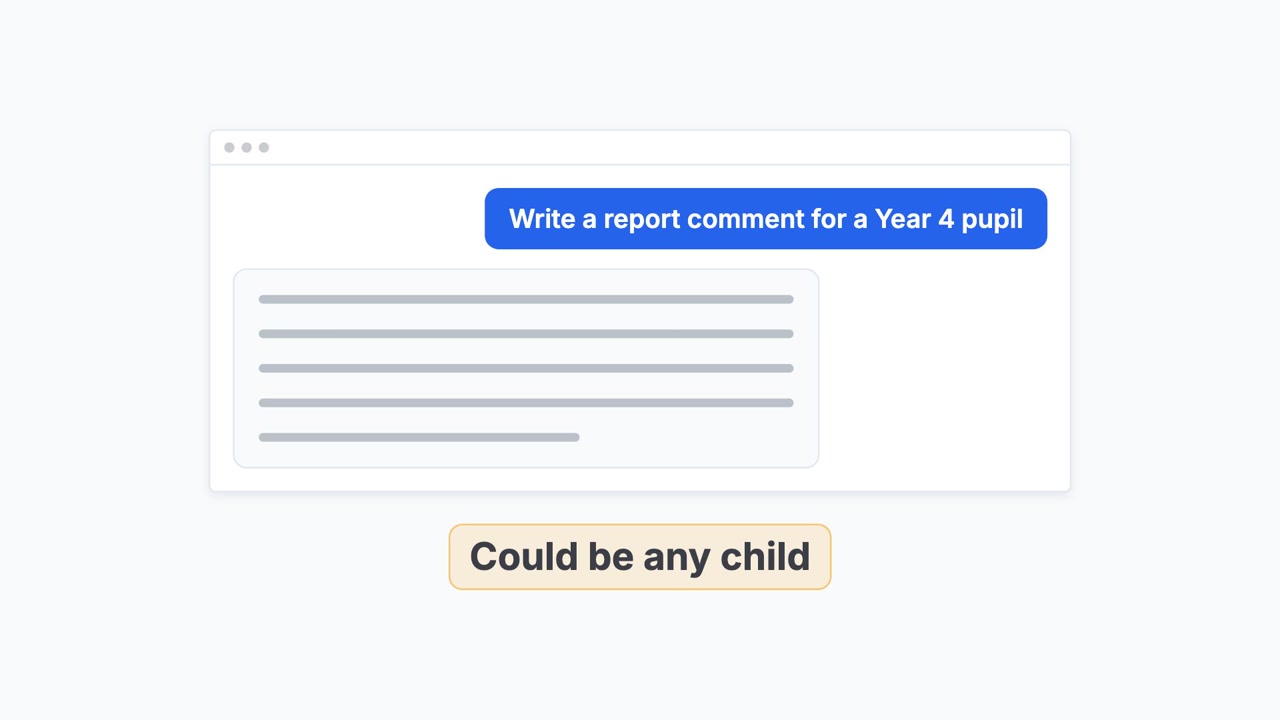
A one-line request leaves an AI chat to guess everything but the job. A good prompt has four parts, the job, the material, the shape of the answer and the reader, shown on one school report comment that goes from generic to ready to use.
Ask an AI chat for a report comment for a Year 4 pupil and you get something polite and general that could describe almost any child. The AI isn’t being lazy. It has one line and nothing else, so it writes the most likely comment for any pupil.
A good prompt covers four parts. The job is the task in plain words, including the outcome you need, such as a comment that gives a parent one thing to practise at home. The material is what it should work from, such as your own notes on the pupil with no name attached. The shape is what the answer should look like, such as three warm sentences ending in one target for September. The reader is who it’s for: parents need everyday words, and a colleague can take teaching language. You don’t need to tell it that it’s an expert, because in tests that made no reliable difference to accuracy. Before you send a request, check it has all four.
The four parts, on one report comment
1 · The jobThe task in plain words, and the outcome you needA comment that gives a parent one thing to practise at home
2 · The materialWhat it should work fromYour own notes on the pupil, with no name attached
3 · The shapeWhat the answer should look likeThree warm sentences ending in one target for September
4 · The readerWho it's forA parent, so everyday words
The advice draws on Google’s Gemini for Workspace prompting guide (2024), Microsoft’s “Learn about Copilot prompts” and the Wharton School’s Prompting Science Report 4 (December 2025). This is an independent explainer, not affiliated with Google, Microsoft or any AI company.
The line to keepBefore you send a request, check it has the job, the material, the shape and the reader.
Ask an AI chat to write a report comment for a Year 4 pupil, and you get something polite and general. It could describe almost any child in the country.
The AI isn't being lazy. It has the one line you typed and nothing else, so it writes the most likely comment for any pupil.
A good prompt covers four parts, which are the job, the material, the shape of the answer and the reader.
The job is the task in plain words, including the outcome you need. Here, that's a report comment that gives a parent one thing to practise at home.
The material is what it should work from. Paste in your own notes on the pupil, with no name attached, like their reading progress and the area they find most challenging.
The shape is what the answer should look like. Ask for three warm sentences, finishing with one simple target for September.
The reader is the person who will read the answer. A comment for parents needs everyday words, while a note for a colleague can use teaching language.
Look again at that first request, and count how many of the four parts it contains.
It has just one of them, the job. The AI had to fill in everything else by guessing.
With all four parts, the same AI chat writes a comment about this pupil, in words a parent understands.
You don't need to tell it that it's an expert teacher. The four parts carry the detail, and the detail is what changes the answer.
Before you send a request, check it has the job, the material, the shape and the reader, every time.
Found this useful?
Subscribe for the next one, or tell me what you want explained. I take requests.